
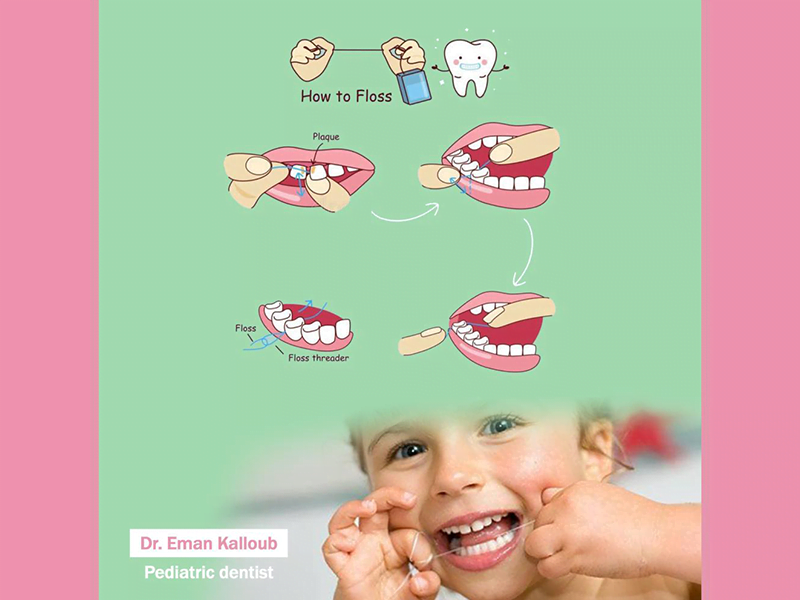
Brushing alone cleans only 60% of tooth surfaces. The remaining 40% — the spaces between teeth — can only be cleaned with floss. As a pediatric dentist in Dubai, I see cavities between teeth far too often, and almost all of them are preventable with daily flossing.
Why Flossing Is Essential
The spaces between teeth are prime real estate for plaque buildup. Food particles and bacteria accumulate there, producing acids that cause interproximal cavities — decay between teeth that is invisible to the naked eye until it becomes severe. These cavities are particularly problematic because they often affect two adjacent teeth simultaneously.
When to Start Flossing
Begin flossing your child\'s teeth as soon as two teeth touch each other — typically around age 2-3. At this age, parents should do all the flossing. Children usually lack the manual dexterity to floss effectively until around age 8-10, so parental assistance is essential until then.
Step-by-Step Flossing Technique
1. Break off about 18 inches of floss. Wind most of it around one middle finger and the rest around the opposite middle finger.
2. Hold the floss tightly between your thumbs and forefingers, leaving about 1-2 inches of floss between your hands.
3. Guide the floss gently between the teeth using a gentle sawing motion. Never snap or force the floss.
4. When the floss reaches the gumline, curve it into a C-shape against one tooth.
5. Slide it gently into the space between the gum and the tooth.
6. Move the floss up and down against the side of the tooth, removing plaque and food particles.
7. Repeat for each tooth, using a clean section of floss each time.
Floss Picks vs. Traditional Floss
Floss picks (small plastic tools with a piece of floss strung between two prongs) are popular with parents because they are easier to use. They are a good starting point, but traditional floss is more effective because it can curve around each tooth in a C-shape. If you use picks, still try to curve the floss against each tooth surface.
Making Flossing a Habit
Flossing should happen once a day, ideally before bedtime. Make it part of the nightly routine — brush, floss, rinse. Let your child pick their floss flavor. Use a flossing chart with stickers. Floss together as a family. Consistency is more important than perfection — even a quick floss is better than none.
Signs You Are Flossing Correctly
If your child\'s gums bleed when you first start flossing, do not be alarmed — this is normal and should stop within a week as the gums become healthier. If bleeding persists after two weeks of daily flossing, schedule a dental visit. Healthy gums should be pink and firm, not red and swollen.
For a hands-on demonstration of flossing technique tailored to your child\'s age and dental development, book an appointment at our Dubai Healthcare City clinic.